Can You Trust the Information in Your Asset Register?
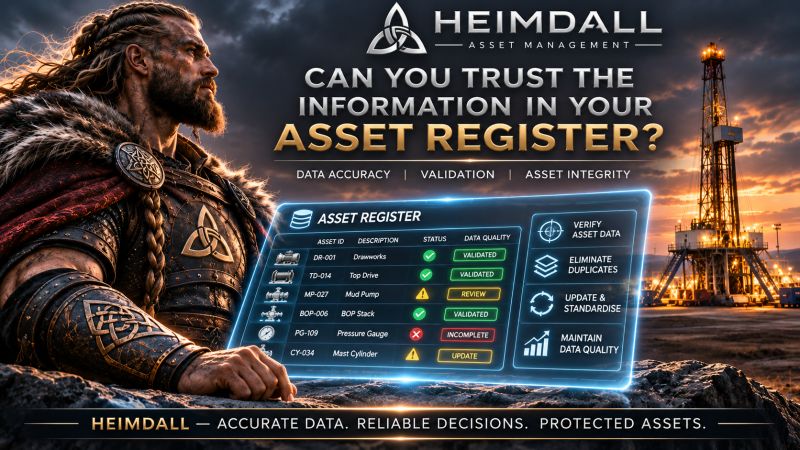
An asset management system can hold thousands of equipment records, schedules, certificates and documents. The number of records, however, says little about how accurately they reflect the equipment operating in the field.
Registers evolve through equipment transfers, personnel changes and software migrations. Without consistent ownership and validation, the information can gradually become incomplete, inconsistent or outdated.
Recognise the signs of declining data quality
Duplicate or missing assets make it difficult to establish a reliable equipment population. Outdated locations, specifications, ownership details and operational status weaken the connection between the record and the physical asset.
Incomplete maintenance histories and incorrectly linked inspection records create further gaps. Different naming conventions and hierarchies across rigs or departments can also make otherwise useful information difficult to compare.
Look behind the dashboard
Work orders, schedules and management reports depend on the information the system contains. An impressive dashboard does not make incomplete source data accurate.
When users cannot rely on the underlying records, they spend more time checking, reconciling and searching. Decisions become harder because the business first has to establish which version of the information is trustworthy.
Make validation an ongoing process
Data quality is not a one-off implementation task. It needs continuing attention as equipment moves, new assets enter service, inspections are completed and operational responsibilities change.
A practical approach includes clear data ownership, consistent classifications and hierarchies, checks for missing or duplicate records, and a process for resolving exceptions. Maintenance, inspection and certification information should remain connected to the correct equipment.
Give the work dedicated ownership
A managed asset management approach can provide the expertise and capacity to maintain registers, standardise structures and support transfers, commissioning and other operational changes.
Data-quality measures and recurring validation help teams see where improvement is needed and whether actions are making the register more reliable. The objective is to maintain confidence in the information, rather than repeatedly undertake a large clean-up after it has deteriorated.
Keep the register connected to the field
Heimdall’s approach starts with reliable, verified asset data, supported by continuing technical oversight, remote and on-site expertise and Heimdall AI. The register should be a useful source of trusted information for the people managing the equipment.
A useful question for asset and maintenance managers is when the register was last independently checked against the equipment actually in operation. That comparison helps reveal the gaps a database review alone may miss.
Read the original LinkedIn post below, or contact Heimdall to discuss asset data validation and ongoing register management.